Solo ads are simple: you pay someone to email their list with your link. You’re buying access to an audience you don’t own, for a short moment, and you’re paying per click most of the time.
For new affiliate marketers, solo ads can feel like a paid shortcut. They can bring traffic fast, but they won’t fix a weak offer, a confusing page, or no follow-up. Think of solo ads like turning on a faucet, if you don’t have a bucket ready, the water just hits the floor.
One hard lesson many beginners learn (me included) is that skipping building an email list early gets expensive. You spend money for clicks, but you can’t reach those people again, so you miss follow-up sales and future commissions. That’s why this guide focuses on sending solo ad clicks into an email list funnel, not straight to an affiliate offer.
Key takeaways: what you need before you buy your first solo ad
An email list (at least a basic opt-in page and follow-up emails).
Use a tracking link so you know which seller and ad produced results.
Start small (test 100 to 200 clicks before buying bigger runs).
Test multiple angles (headlines, lead magnets, and email swipes).
Watch your opt-in rate and EPC (earnings per click), not just click counts.
Avoid sellers who make unrealistic promises or won’t answer basic questions.
Focus on long-term ROI, not same-day profit from a single email blast.
How solo ads work, and when they make sense for affiliate offers
A solo ad is rented attention. A vendor has an email list, they send an email to that list, and your link is the main call to action. In many deals, you pay per click (for example, $0.50 to $1.50 per click, though prices vary by niche, quality, and location).
This is different from other traffic sources:
SEO brings steady traffic over time, but it’s slower and takes content work.
Social media can be free, but it’s unpredictable and often requires daily posting.
Ad platforms (like Google or Meta) can scale, but they come with approval rules and a learning curve.
Solo ads can make sense when your goal is list building and you have a clear funnel. They’re often best for:
A simple lead magnet that matches a known problem
A low-friction opt-in page (one clear action)
A basic email sequence that does the selling over several days
They’re a poor fit when you don’t have the basics in place, like:
No opt-in page, just an affiliate link
No follow-up emails
No tracking
A tiny budget where one bad test wipes you out
Here’s the core risk to understand: you’re renting clicks, not building an asset unless you capture the email. If you collect subscribers, you keep the value after the traffic stops.
Solo ads vocabulary you must understand (clicks, opt-ins, EPC, ROI, tier 1 traffic)
You don’t need to talk like a media buyer to run solo ads, but you do need to understand the numbers.
Clicks: How many times people clicked your link. Ask for unique clicks when possible (one person clicking five times shouldn’t count as five people).
Opt-ins: How many visitors joined your email list. This is where the asset starts.
EPC (earnings per click): Your total earnings divided by clicks. If 200 clicks produce $60, your EPC is $0.30.
ROI (return on investment): Profit compared to spend. If you spend $200 and earn $260, your ROI is positive. If you earn $120, it’s negative.
Tier 1 traffic: Usually means higher-income countries (often US, UK, CA, AU, NZ). It can cost more, and quality can still vary by seller.
A simple example helps connect the dots:
You buy 100 clicks at $1 each = $100
Your opt-in page converts at 30% = 30 subscribers
Over the next week, 2 people buy a $50 commission offer = $100 earned
In this example, you broke even quickly, but you also gained 30 subscribers. If more people buy later, the run becomes profitable over time. That’s why solo ads work best when you treat them like a list-building play, not a one-shot sale.
The biggest beginner mistake: paying for clicks that you cannot follow up with
Sending solo ad traffic straight to an affiliate link is a complete No-No – for one reason: most people won’t buy on the first click.
Cold traffic often needs repetition. They need to understand who you are, what the offer does, and whether they trust it. Without an email list, you can’t do any of that. The only way back to the same person is to pay for more clicks – but with a good solo-ad provider you would expect different visitors, not ones you paid for last time!
That’s the trap that drains budgets. You buy traffic, get a few sales (or none), and then you’re forced to start over from scratch. When you capture the email first, you can keep marketing to the same people, test different offers later, and recover from a weak first day. The list turns paid clicks into something you still own next week.
Set up a simple solo ad funnel that turns clicks into subscribers and sales
Your funnel doesn’t need to be fancy. It needs to be clear, fast, and focused on one action.
A beginner-friendly solo ad funnel usually looks like this:
Solo ad email (sent by the vendor)
Your opt-in page (collect the email)
Thank-you page (deliver access, set expectations)
Follow-up emails (build trust, then recommend an offer)
Offer page (affiliate product or service)
Here’s a mini checklist to get ready before you buy clicks:
Domain (a simple branded domain helps trust)
Landing page (opt-in page, mobile-first)
Thank-you page (deliver the lead magnet and next steps)
Email service provider (to store leads and send emails)
Tracking (so you can measure seller quality and results)
5 to 7-day follow-up sequence (written and loaded before traffic starts)
One more detail matters more than most people think: match the lead magnet to the offer. If your lead magnet attracts the wrong crowd, you’ll grow a list that clicks but doesn’t buy.
Choose a lead magnet that attracts buyers, not freebie hunters
A good lead magnet solves a small, real problem and hints at a bigger solution. It should attract people who are already interested in the type of product you plan to recommend.
Lead magnet ideas that work well with many affiliate niches:
Checklist: “Before you buy X, check these 12 things.”
Cheat sheet: “The quick settings that fix the most common problem.”
Short email course: 5 days, one clear win per day.
Tool list: “My starter tools for doing X (with free and paid options).”
Quick-start guide: “Start here, do this in 30 minutes.”
Message match is the rule. The promise in the solo ad email, the headline on your opt-in page, and the lead magnet title should all point to the same outcome. If the email says “free meal plan,” but the page offers “workout tracker,” your opt-ins will drop, and the seller will look worse than they are.
Build your landing page for one job: the opt-in
Your opt-in page has one job: get the email. Not educate. Not pitch five products. Not tell your whole life story.
Keep it tight:
Clear headline that repeats the solo ad promise in plain language
3 benefit bullets that tell people what they’ll get
One call to action (email form and button)
Trust cues (privacy line, no spam promise, your name or brand)
Mobile-first design (big text, fast load, easy form)
What’s a “good” opt-in rate? It depends on niche, device, and lead magnet quality, but many marketers aim for something like 20% to 40% on cold traffic. If you’re far below that, test basics before blaming the traffic:
Headline and subhead (does it match the email?)
Lead magnet angle (is the outcome clear?)
Form placement and button text
Page speed (slow pages kill conversions)
Too many distractions (menus, extra links, clutter)
You don’t need perfection, you need a page you can improve run by run.
Write a short follow-up sequence that does the selling for you
Once someone opts in, the clicks have done their job. Now your emails do the heavy lifting.
A simple 5 to 7 email sequence can look like this:
Email 1 (instant): Deliver the lead magnet, set expectations for the next few days.
Email 2: Share a quick win they can use in 10 minutes.
Email 3: A short story and lesson (what went wrong, what fixed it).
Email 4: Soft pitch the affiliate offer as a next step.
Email 5: FAQ style, answer common objections and concerns.
Email 6: Stronger call to action with clear benefits and who it’s for.
Email 7: A simple last chance or reminder (no hype, just clarity).
This is where the email list becomes the asset. When the solo ad run ends, you can still follow up, send more value, and recommend other related offers later. That’s how you stop paying for the same attention again and again.
If you dread the thought of writing email follow-ups, let AI do it for you. I used to think I wasn’t bad at writing follow-ups, but then I started letting AI do it for me, and I hate to confess, but the AI was more thorough than I was. Of course I tweak it a bit to put my own voice on – as you always should with AI – but not let the fear of writing email follow-ups stop you from building an email list.
Buying solo ads the smart way: pick sellers, track results, and scale without wasting money
Solo ads are simple to buy and easy to mess up. The difference between a decent run and a money pit often comes down to seller choice and tracking.
Think like a tester, not a gambler. Your first goal is not profit. Your first goal is data you can trust: opt-in rate, cost per lead, and whether subscribers engage and buy over time.
A smart buying process looks like this:
Choose one seller
Buy a small click package
Track everything
Improve one weak point
Repeat with the same seller or compare a new one
That approach keeps your losses small and your learning fast.
How to find a solo ad vendor
Top tip! Completely avoid those “messenger pests” who will send DMs to you on social media. The minute they realise you’re an affiliate marketer, they will be trying to sell you their solo-ads. If their traffic was any good, YOU would be seeking them out, NOT them seeking you out.
Using a supplier whop has been recommended to you, by someone you trust, is good.
Here’s a supplier I’ve had good results from: LeadHero.
Udimi is a Marketplace for Solo Ad Vendors
Udimi is a popular online marketplace that connects solo ad buyers with sellers, offering a platform where you can browse various list owners and purchase clicks to your offers.
If you’re looking for a reliable way to get eyes on your offer, Udimi is a good place to start.
What makes it work is the community feedback—every seller has a public track record. You can browse through real reviews and ratings to see who is consistently delivering quality results. This takes the guesswork out of buying traffic, allowing you to find dependable partners and protect your investment from the start.
TrafficZest is a modern, high-speed alternative to traditional solo ad marketplaces. Instead of buying from one seller at a time, it works like a “search engine” for traffic, aggregating clicks from a massive network of vetted providers into one simple dashboard.
The key advantages are:
Instant Scaling: You set a daily budget and the platform pulls traffic from multiple sources simultaneously, so you don’t have to hunt for individual vendors.
Precision Targeting: You have granular control over “Tier 1” countries, device types, and specific traffic sources.
Real-Time Optimization: You can instantly “blacklist” underperforming sources and “whitelist” the ones that are actually generating sales.
Fresh Leads: Their strict vetting process focuses on active, responsive leads rather than over-mailed lists.
In short, it’s a faster, more automated way to get high-quality traffic without the manual back-and-forth of traditional solo ads.
It is recommended by some very large email marketers and I have had some success using their traffic – again you can test small quantities.
You can’t fully “verify” traffic quality ahead of time, but you can filter out many bad options with a few checks.
Ask the seller:
Do you have recent proof of results (screenshots are not perfect, but better than nothing)?
What niche is your list interested in?
How often do you mail, and how do you keep the list fresh?
What counts as a click, do you report unique clicks?
What are your click guarantee rules (make-up clicks, time frame)?
Can you target countries or devices (if your offer needs it)?
Do you allow tracking links?
Watch for red flags:
Big income claims and hype instead of clear answers
They don’t ask what you’re promoting or what your funnel is
They refuse to share basics about click reporting and guarantees
Pressure tactics like “last spot, pay now” with no details
A good seller cares about fit because refunds and complaints hurt them too.
What to track on every run (and the few numbers that matter most)
If you track nothing, every solo ad feels random. If you track a few key numbers, patterns show up quickly.
Track these on every run:
Delivered clicks vs unique clicks (quality starts here)
Opt-in rate (subscribers divided by clicks)
Cost per lead (spend divided by opt-ins)
EPC (earnings divided by clicks)
Refund rate (if your offer has frequent refunds, it affects true profit)
ROI over 7 to 30 days (many runs win later, not day one)
Use a tracker and tag each run by seller name, date, and email swipe angle. Sometimes a seller is fine, but one swipe pulls poor-fit clicks. Without tags, you won’t know what to fix.
How to test and scale: start small, improve one thing, then increase clicks
Scaling only works when the funnel is already working. If you scale a bad funnel, you don’t “test faster,” you just lose money faster.
A simple plan that works for beginners:
Buy 100 to 200 clicks from one seller.
Test two landing page headlines (keep the page the same otherwise).
If opt-ins are decent, test two angles (lead magnet topic or email swipe).
Track results for at least 7 days after the run.
Scale the winner slowly (for example, 200 clicks, then 300, then 500).
Change one thing at a time. If you change the seller, the page, and the emails all at once, you’ll never know what caused the improvement (or the drop).
An alternative to solo-ads – Twice Confirmed Traffic
Unlike traditional solo ads where you pay per click to send traffic to a single offer, Twice Confirmed Traffic (affiliate link) gives you a smarter, more flexible option.
For roughly the same price as one solo ad campaign, you can test multiple links at once—meaning you’re not locked into promoting just one product or funnel. This is a game-changer if you’re still figuring out what converts best, or if you want to split-test different offers without spending hundreds of dollars on separate campaigns. You get quality, targeted buyer traffic that’s been double-confirmed (hence the name), and the ability to diversify your testing strategy without multiplying your ad spend.
It’s one of the most cost-effective ways to gather real data and find your winning offer fast.
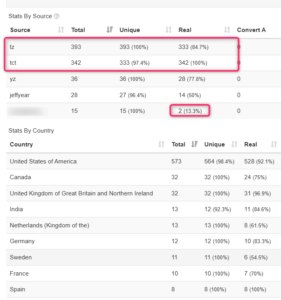
My stats on the right (tracked by LeadsLeap) show that TCT was one of my best converting sources of ads – as in getting optins to my squeeze pages. After that it’s down to your conversion / follow-up process to turn optins into sales.
Inside their site, you can review what offers have turned into sales. You can read more at the Twice Confirmed Traffic site (affiliate link).
My own experiences with solo ads
With the limited tests I have done, the truth is I’ve never been enthusiastic enough about the results to place very large follow-up orders. However, it’s possible I need to be more consistent.
In fairness my mediocre results could be down to the quality of the follow-up series I am using – some mine, and some provided automatically by programs I am involved with.
On the other side of the coin, I know that some affiliates have built huge email lists purely from solo-ads, and they have recommeded them to me.
In my opinion using solo-ads certainly beats the alternative of ‘chatting to people on Facebook’ and ‘making friends’, which I just haven’t got the patience to bother with.
I keep a regular purchase of Twice Confirmed Traffic (affiliate link) although as mentioned, that’s not strictly a solo-ad vendor.
I would say that Lead Hero comes the most highly recommended solo-ad vendor of all by my fellow affiliate marketers, and I have made actual sales from this traffic.
Solo Ad FAQs new affiliate marketers ask all the time
Are solo ads safe?
They can be, but quality varies a lot. The main safety issue is wasting money on low-quality clicks or sellers who won’t honor guarantees. Start small, track results, and avoid hype-driven sellers.
How much should I budget for my first solo ad test?
Budget enough for a small test and the tools to capture leads (email service provider and tracking). Many beginners start with 100 to 200 clicks, then decide based on cost per lead and follow-up results.
Should I send solo ad traffic to a bridge page or an opt-in page?
For most beginners, an opt-in page is the safer choice because you capture the email first. A bridge page can work, but it often adds friction and can lower opt-ins if it’s too long or too salesy.
What’s a good opt-in rate for solo ad traffic?
It depends on niche and message match. Many campaigns aim for 20% to 40%, but the real target is improving your own numbers over time. If you’re under 15%, look at your headline, lead magnet, and page speed first.
Can I promote ClickBank offers with solo ads?
Yes, many affiliates do, but the offer still needs to match your lead magnet and emails. Also watch refund rates and compliance rules. Some products convert well upfront, others need more trust-building.
How long until I see sales?
Sometimes same day, sometimes not for a week or more. That’s why tracking over 7 to 30 days matters. The email sequence often produces the results, not the first click.
What niches work best with solo ads?
Solo ads tend to work best in niches where email marketing is already common and people buy based on information and trust (not impulse). The stronger your lead magnet and follow-up, the more niches become possible.
Do I need a custom domain and tracking?
You don’t need a fancy brand, but a custom domain helps trust and deliverability. Tracking is strongly recommended because it shows which sellers and angles work, so you can spend with confidence.
Conclusion
Solo ads can be a useful way to generate website traffic fast, but only when you have a clear funnel, solid tracking, and follow-up emails ready to go. The real win is not the click, it’s the subscriber you can keep talking to after the run ends. Skipping the email list is how beginners burn money and miss commissions that would’ve come later. Set up your opt-in page and 5 to 7-day sequence, then run one small, tracked test buy and improve from there.
Learn how to choose the right niche for your retirement side hustle. Align your passions with market demand to create a sustainable and rewarding online business.
A very informative and comprehensive article Joy with good advice. I’ve come across some marketers who don’t recommend Udimi as they say that some sellers send bot traffic. I did buy some traffic for a promotion (not from Udimi) where the leads were also listed in the members area but those leads were blocked from being listed as they were deemed to be from bots even though they got onto my list and opened my emails. As you say it’s best to select sellers that have been recommended by someone you trust.
I agree, best to stick with personal recommendations and I don’t use Udimi myself much. When I did, I was lucky.
However if you track the traffic they send with LeadsLeap, and it showed it was bots, you could then go back to the vendor with proof and ask for re-run.
Anyone else you find who is reliable, let me know please, and I’ll do the same for you.
Type to see results. Up and down to move, Enter to open.Esc closes
We use cookies
We use cookies to keep the site working, remember your preferences, understand how it is used and, with your permission, measure our marketing. You choose which.
We use cookies to keep the site working, remember your preferences, understand how it is used and, with your permission, measure our marketing. You choose which.







A very informative and comprehensive article Joy with good advice. I’ve come across some marketers who don’t recommend Udimi as they say that some sellers send bot traffic. I did buy some traffic for a promotion (not from Udimi) where the leads were also listed in the members area but those leads were blocked from being listed as they were deemed to be from bots even though they got onto my list and opened my emails. As you say it’s best to select sellers that have been recommended by someone you trust.
I agree, best to stick with personal recommendations and I don’t use Udimi myself much. When I did, I was lucky.
However if you track the traffic they send with LeadsLeap, and it showed it was bots, you could then go back to the vendor with proof and ask for re-run.
Anyone else you find who is reliable, let me know please, and I’ll do the same for you.